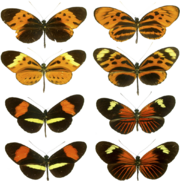
In nature, animals will use bright colors to warn other organisms that they are distasteful or potentially dangerous (Like the Gila Monster pictured above). Bright colors like red, yellow, or orange are typically seen. In something called Mullerian mimicry, venomous or poisonous animals that are unrelated share warning coloration. An example of this is wasps and hornets or butterflies.
Interestingly, another type of mimicry is Batesian mimicry, where a harmless animal mimics the coloration of a dangerous animal. A great example of this is the Coral Snake and the Milk Snake. Both have red, black, and yellow coloration though only 1 is venomous.
The adage used to determine the difference between the two is:
If red touches yellow, you're a dead fellow
If red touches black, you're okay, Jack
This means if the red coloration touches a black band of coloration the snake isn't venomous, but if the red coloration touches a band of yellow coloration the snake is.
Which of these 2 snakes would you expect to be venomous?
A)
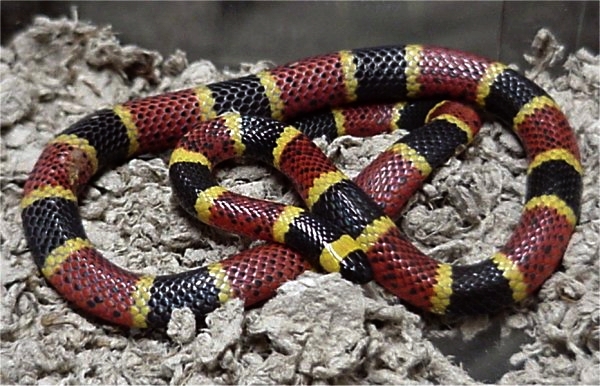
B)


 Crocodilia: Includes crocodiles, alligators, gavials and caimans
 Sphenodontia: Tuataras